
Last Verified: Jun 2026 | By SimOwner.net.pk Editorial Team — Pakistan’s SIM fraud documentation specialists since 2015
A six-digit code arrives on your phone. You did not request it. Ten seconds later, your phone rings — someone claiming to be from your bank, JazzCash, or NADRA, telling you they need that code “to verify your account” or “process your payment” or “protect you from fraud.”
You read them the code. Within seconds, your account balance disappears.
This is Pakistan’s most common digital fraud — the OTP (One-Time Password) scam — and it succeeds not because victims are careless but because the social engineering behind it is sophisticated, the urgency it creates is psychologically overwhelming, and most Pakistanis have never been told the single most important rule about OTPs: no legitimate entity ever needs you to share an OTP with them.
This guide documents every method criminals use to intercept or extract OTPs in Pakistan, explains why each method works, and provides the specific protective measures that make your OTPs uninterceptable. Check your SIM registration status at SimOwner.net.pk first — because many OTP attacks begin with SIM fraud.
Why OTPs Are Pakistan’s Most Attacked Security Layer
OTPs (One-Time Passwords) — the 4–6 digit codes sent via SMS to verify transactions, logins, and account changes — were introduced as a second security factor to complement passwords. The logic was sound: even if a criminal has your password, they cannot complete a transaction without the OTP that goes to your phone.
But this logic breaks down in three scenarios that are extremely common in Pakistan:
Scenario 1 — The criminal controls your phone number. Through SIM swap or MNP fraud, the criminal receives your OTPs because your number now directs to their device. Your bank sends the OTP to “your number” — but it arrives on the criminal’s phone.
Scenario 2 — You share the OTP voluntarily. Through social engineering, the criminal convinces you to read the OTP to them — appearing to be a bank agent, government official, or technical support person.
Scenario 3 — Malware intercepts the OTP on your device. Malicious apps with SMS read permissions capture OTPs and transmit them to criminal infrastructure before you even see them.
Understanding which of these three vectors is targeting you determines which protection is most needed.
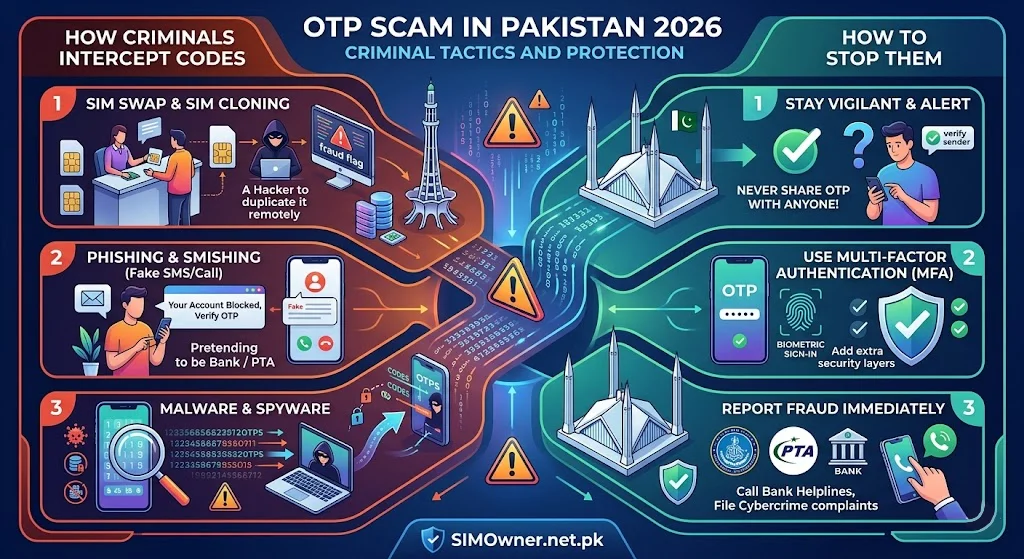
The 6 OTP Interception Methods Used in Pakistan
Method 1 — SIM Swap OTP Theft (Most Damaging)
How it works: The criminal registers a new SIM on your network using your CNIC (through franchise bypass). Your original SIM loses service. The new SIM — in the criminal’s hands — receives all SMS messages, including OTPs.
What they target: JazzCash, Easypaisa, bank transaction OTPs, WhatsApp verification codes.
Scale of financial damage: Typically Rs. 20,000–500,000 in a single attack — because all financial OTPs for the duration of the SIM swap go to the criminal.
Detection: Your phone shows “No Service” or “SIM Not Registered.” Check SimOwner.net.pk’s SIM info tools immediately if this happens.
Protection: Monthly 668 SIM checks, network account fraud flags, WhatsApp Two-Step Verification PIN (cannot be bypassed even with your OTP).
Method 2 — Social Engineering OTP Extraction (Most Common)
How it works: The criminal calls you impersonating a bank agent, NADRA officer, JazzCash representative, or government official. They create a convincing scenario:
“Your account has been flagged for suspicious activity. To protect you, we need to verify it right now. A code will arrive on your phone — please read it to me so we can confirm your identity.”
The OTP arrives (the criminal has already initiated a transaction or login attempt on your account). You read it out. They enter it. The transaction completes.
Why it works: The scenario creates urgency and appears protective. The OTP arriving after the call “proves” the caller is real (they don’t explain they triggered it themselves). The social dynamic of a professional caller asking for help is psychologically difficult to refuse.
Scale: Pakistan’s most frequent OTP fraud type. Average loss: Rs. 5,000–100,000.
The rule: No legitimate bank, JazzCash, NADRA, PTA, or any real organization ever asks you to read an OTP to them. Ever. The OTP is for you to enter — not to share.
Method 3 — SMS Malware on Android Devices
How it works: Malicious Android apps — typically disguised as utility apps, prize notification apps, or fake bank apps promoted on social media — request SMS read permissions during installation. Once installed:
- The app runs silently in the background
- Every SMS received (including OTPs) is automatically forwarded to criminal servers
- The criminal enters your captured OTP before you even notice the SMS arrived
Pakistan-specific context: Android devices dominate Pakistan’s smartphone market. Several documented Pakistani malware campaigns have distributed OTP-stealing apps through WhatsApp forwards (“Download this app, get free internet/data/Telenor packages”).
Detection: Unusual battery drain, excessive background data usage, SMS apps you did not install.
Protection:
- Only install apps from official Google Play Store or Apple App Store
- Never install APK files shared via WhatsApp or links
- Periodically review app permissions — revoke SMS read access from any app that does not specifically need it
- Install a reputable antivirus (Malwarebytes, Bitdefender — both have free Android versions)
Method 4 — Phishing Links Leading to Credential + OTP Capture
How it works: A fake website — mimicking HBL, MCB, JazzCash, or any major Pakistani financial service — is created with a nearly identical URL. A text or WhatsApp message sends you to this fake site:
“Your JazzCash account will be suspended. Verify immediately: [fake URL]”
You enter your login credentials. The site captures them and simultaneously attempts login on the real JazzCash. JazzCash sends an OTP to your phone. The fake site displays a field saying “Enter the code sent to your phone for verification.” You enter it. The fake site passes it to the criminal who completes the login on the real platform.
Detection: Check URLs carefully — real JazzCash is jazz.com.pk/jazzcash, not jazzcash-verify.com or similar. Banks and JazzCash never send login links via SMS or WhatsApp.
Protection: Never click financial service links in SMS or WhatsApp. Always type the URL directly.
Method 5 — SS7 Protocol Interception (Sophisticated, Rare)
How it works: As covered in our dedicated SS7 guide, attackers with access to the telecom signaling network can intercept SMS messages — including OTPs — in transit. This is a network-infrastructure level attack that does not require access to your device.
Pakistan relevance: SS7 attacks require significant technical capability and network access — not the tool of ordinary criminals. Risk is primarily for high-value targets (executives, politicians, large account holders). For most Pakistanis, social engineering OTP theft (Method 2) is a vastly more likely threat.
Protection: Authenticator apps (Google Authenticator) — which generate codes locally without SMS — are immune to SS7 interception.
Method 6 — Fake OTP Request (Credential + OTP Harvest in Sequence)
How it works: The criminal already has your login credentials (from a breach database or previous phishing). They initiate a login attempt on your banking app. The bank sends an OTP to your phone. The criminal calls you immediately:
“I’m from [Bank Name] security team. Someone is trying to access your account. We sent you an OTP to stop this — please confirm the OTP to block the unauthorized access.”
You confirm the OTP thinking you are blocking fraud. You have actually authorized it.
The psychological trap: This method is particularly effective because it frames the OTP request as protection from fraud — not as fraud itself. Victims genuinely believe they are being helpful.
The rule (again): If confirming an OTP would protect your account, the bank would not need you to read it to a caller. Banks stop unauthorized transactions by blocking the transaction — not by asking you for codes.
The Single Most Important OTP Protection Rule
Before covering technical protections, this rule is the most valuable thing in this guide:
An OTP is a secret that belongs only to you. No bank, no JazzCash, no NADRA, no PTA, no police officer, no “technical support,” no “security team” ever has a legitimate reason to ask you to share an OTP. If anyone asks — it is fraud. Full stop.
This rule, communicated clearly to every family member — especially elderly parents who are primary social engineering targets — prevents the majority of OTP fraud without any technical intervention.
7 Proven OTP Protection Measures
Protection 1 — Switch to Authenticator Apps Where Available
TOTP authenticator apps (Google Authenticator, Microsoft Authenticator) generate codes on your device without any SMS involvement. They cannot be intercepted via SIM swap, SS7, or social engineering (because the code changes every 30 seconds and is generated locally).
Enable on: Gmail/email, Facebook, Instagram, Twitter — any account that supports it.
Limitation: Most Pakistani bank apps and mobile wallets still rely on SMS OTP. Lobby your bank for authenticator app support as a security feature request.
Protection 2 — Monthly SIM Check (Prevents SIM Swap OTP Theft)
Send your CNIC to 668 monthly. Any unauthorized SIM means your OTPs are at risk of being redirected. Act immediately on any unrecognized SIM.
Monitor your SIM status continuously using the SimOwner.net.pk live tracker.
Protection 3 — Network Account Fraud Flags (Prevents SIM Swap)
Call Jazz (111-225-111), Zong (310), Telenor (345), Ufone (333). Request in-person biometric required for any SIM replacement. This is the most direct prevention for SIM swap OTP attacks.
Protection 4 — WhatsApp Two-Step Verification PIN
WhatsApp → Settings → Account → Two-Step Verification → Enable.
Even if someone SIM-swaps your number, they cannot re-register your WhatsApp without this PIN. Protects WhatsApp OTP-based account takeover entirely.
Protection 5 — Android App Permission Audit
Go to: Settings → Apps → (select each app) → Permissions → SMS.
Revoke SMS read permission from any app that does not have a clear legitimate need. Your bank app needs it. A flashlight app does not.
Protection 6 — Low Mobile Wallet Transaction Limits
JazzCash → Settings → Wallet Settings → Daily Transaction Limit: Set to minimum you actually need.
Limits maximum damage even if OTP is compromised. A Rs. 5,000 daily limit means a criminal who intercepts one OTP can steal at most Rs. 5,000 — not your entire balance.
Protection 7 — “Call Me Back on Official Number” Protocol
If you receive an OTP you did not request and then a call asking for it — hang up immediately. Call the official bank/JazzCash number yourself (from the back of your card or official website — not any number the caller gave you) to verify whether there is actually an issue with your account.
This 60-second verification step catches virtually every Method 2 and Method 6 social engineering attack.
Teaching Your Family — The Most Impactful Prevention
Individual OTP protection matters, but family education matters more — because elderly family members are primary social engineering targets for Pakistani OTP scams:
Key messages for elderly parents:
- “Koi bhi code share na karo — chahe konsa bhi claim kare” (Never share any code — regardless of what they claim)
- “Agar koi code maange — pehle mujhe call karo” (If anyone asks for a code — call me first)
- “Bank kabhi bhi phone par code nahi mangta” (Banks never ask for codes by phone)
These three sentences, understood and practiced, prevent virtually all social engineering OTP fraud against elderly family members.
Responding to an OTP You Did Not Request
If you receive an OTP you did not request — take these steps immediately:
Step 1: Do not share it with anyone.
Step 2: If it is a banking OTP — call your bank immediately on the official number. Someone may have your login credentials and is attempting a transaction. Your bank can freeze your account proactively.
Step 3: If it is a WhatsApp verification code — someone is trying to re-register your WhatsApp on a new device. Go to WhatsApp → Settings → Account → Two-Step Verification and ensure it is enabled. Change your WhatsApp linked email password as a precaution.
Step 4: Check your SIM is still active — call your own number from another phone. If it does not ring through to your device, a SIM swap may be in progress. Call your network’s fraud line immediately.
Frequently Asked Questions
Q: I shared an OTP by mistake. What should I do immediately? A: Act in this exact order: (1) Call your bank/JazzCash/Easypaisa fraud line immediately — freeze the account. (2) Change your password on the affected service from a different device. (3) Check if any transaction completed — get the reference number if yes. (4) File FIA complaint at complaint.fia.gov.pk with the scammer’s phone number and all details. Speed is critical — every minute the account remains unfrozen increases potential loss.
Q: My JazzCash was drained after I received an OTP. Can I get the money back? A: File immediately with JazzCash (051-111-952-952) — report the unauthorized transaction with the reference number. JazzCash has a fraud reversal process. File FIA complaint simultaneously. Recovery success rate is significantly higher when reported within 2 hours of the transaction.
Q: Can I identify who called me for the OTP scam? A: The scammer’s number is typically registered to a CNIC through Pakistan’s mandatory registration system — making them traceable. Include the scammer’s phone number in your FIA complaint. FIA can subpoena registration records from the operator to identify the CNIC registered to the number.
Q: My bank says I authorized the transaction (because the OTP was entered). Do I have any recourse? A: Yes — under SBP’s consumer protection framework, transactions authorized through fraudulent social engineering are disputable. File a formal written complaint with your bank, explicitly stating the OTP was extracted through social engineering fraud (not shared voluntarily in the normal sense). Include FIA complaint reference. Escalate to SBP’s Banking Mohtasib if bank is unresponsive.
Q: Is it safe to receive OTPs on a dual SIM phone? A: Safety depends on which SIM the OTP is sent to. Using the dual SIM security framework — keeping your banking OTP SIM private and separate from your public number — significantly reduces social engineering targeting of your OTP SIM.
Summary: OTP Scam Prevention Quick Reference
| OTP Threat | Best Protection |
|---|---|
| SIM swap OTP theft | Monthly 668 check + network fraud flag |
| Social engineering call | “Never share OTP” rule — no exceptions |
| Android malware | Official apps only + SMS permission audit |
| Phishing site | Never click financial links in SMS/WhatsApp |
| SS7 interception | Authenticator app (Google Authenticator) |
| Credential + OTP harvest | “Call back on official number” protocol |
The one rule that stops most OTP fraud: No legitimate organization ever asks you to share an OTP. If anyone asks — it is fraud.
For complete SIM protection, verification tools, and Pakistan’s most comprehensive fraud prevention resources, visit SimOwner.net.pk — Pakistan’s trusted SIM security resource since 2015.
All technical details and fraud statistics verified from FIA public data and cybersecurity research as of Jun 2026. SimOwner.net.pk is not affiliated with any financial institution, network operator, or government entity.
Related Guides on SimOwner.net.pk:
- SIM Swap Attack — First 60 Minutes Emergency Protocol
- WhatsApp Hacked via SIM Swap — Recovery Guide
- SS7 Attack Pakistan — Can SMS OTPs Be Intercepted?
- Pakistan Identity Theft — How It Starts With SIM Fraud and How to Stop It Completely (2026)
- Jazz USSD Codes Complete List 2026 — All *321# Codes, Balance Check, and Hidden Features