
Last Verified: May 2026 | By SimOwner.net.pk Editorial Team — Pakistan’s SIM security specialists since 2015
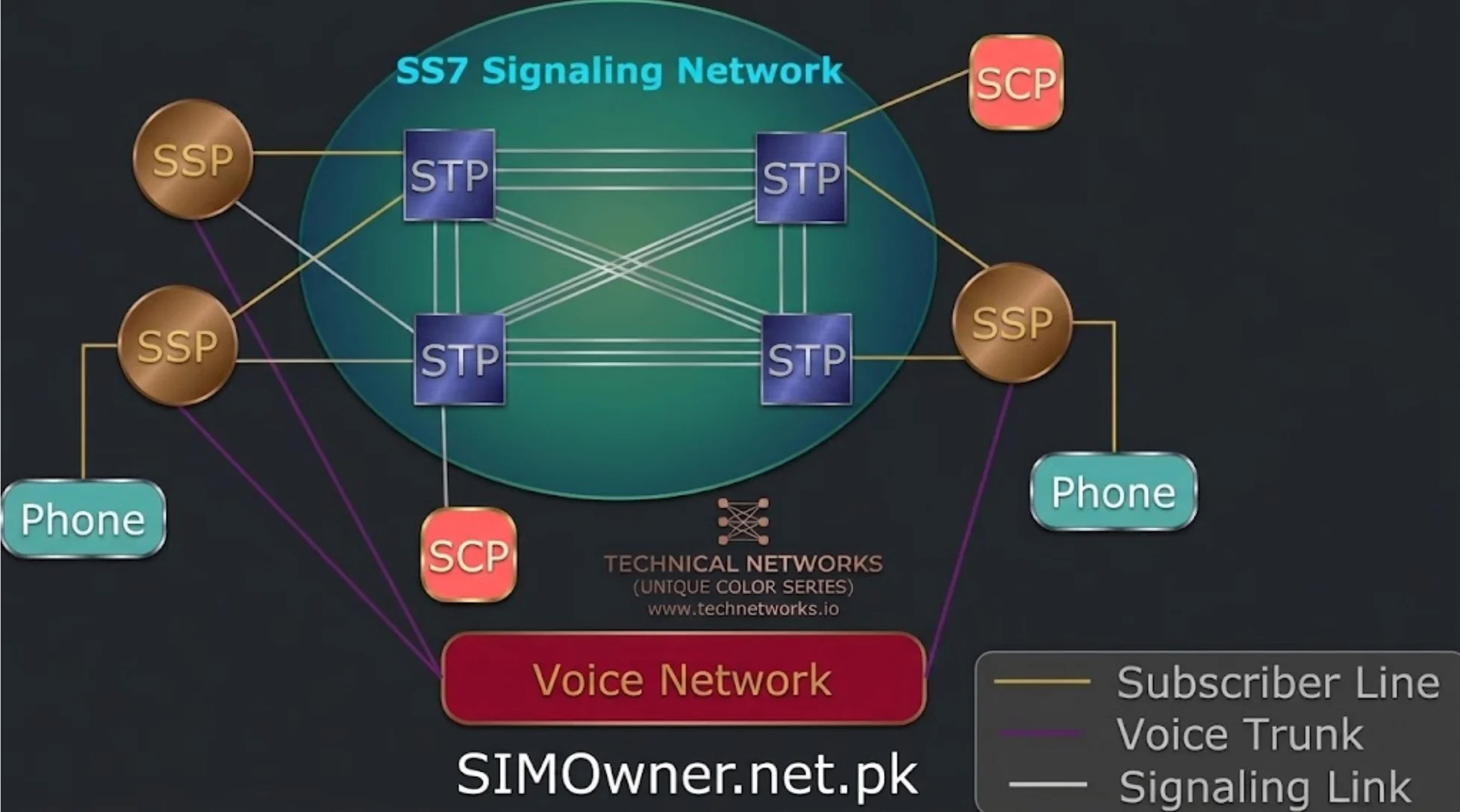
Every time your bank, JazzCash, or any Pakistani digital service sends you a 6-digit code via SMS, that message travels through a global telecommunications infrastructure built on protocols designed in 1975. Those protocols — collectively called SS7 (Signaling System No. 7) — were never designed with security in mind, because when they were created, the only people who could access the telecom signaling network were the telecom companies themselves.
That assumption is no longer valid. And the consequences for anyone relying on SMS OTPs for security are significant.
This guide explains what SS7 is, how SS7 attacks work, what the actual risk level is for Pakistani users specifically, why SMS OTP is considered a weak second factor by the global cybersecurity community, and — most importantly — what concrete alternatives protect you. The goal is not to alarm but to inform: understanding SS7 helps you make better security choices, particularly around your SIM-linked accounts that can be monitored at Pak SIM Data.
What Is SS7 and Why Does It Matter for Your OTPs?
SS7 (Signaling System No. 7) is a set of telephony signaling protocols used by virtually every telecommunications network in the world to exchange information necessary for routing calls and SMS messages. When you call someone — whether next door or internationally — SS7 is the invisible infrastructure that routes that call, manages billing, handles roaming, and enables your messages to find you anywhere in the world.
SS7 handles fundamental telecom functions including:
- Location registration: Telling the network where you are (which cell tower you are near) so calls and SMS can reach you
- Call routing: Directing calls from origin to destination across networks
- SMS delivery: Routing text messages to the correct subscriber globally
- Roaming: Enabling your Pakistani SIM to work when you travel abroad
The critical vulnerability: SS7 was designed assuming that only authorized telecom operators would have access to the signaling network. But over decades, access to SS7-connected nodes has expanded — to MVNOs (Mobile Virtual Network Operators), to telecom equipment providers, and in some cases, through criminal channels, to unauthorized parties who have purchased or hacked their way into SS7-connected systems.
An attacker with SS7 access can send SS7 protocol messages that instruct the global telecom network to route calls and SMS messages intended for your number to a different location — one under the attacker’s control. This is technically distinct from SIM swap (which requires physical presence at a franchise) or MNP fraud (which uses the legitimate porting system). SS7 attacks happen entirely within the telecom signaling layer, invisible to both the victim and the victim’s home network.
How an SS7 SMS Interception Attack Works — Step by Step
A targeted SS7 SMS interception attack against a Pakistani user would follow this sequence:
Step 1 — Attacker gains SS7 access. This is the barrier that makes SS7 attacks rare compared to SIM swap fraud. Gaining access to an SS7-connected node requires either compromising a legitimate telecom system, purchasing access through criminal underground markets (where some operators in less-regulated jurisdictions sell SS7 access), or exploiting vulnerabilities in telecom equipment exposed to the internet.
Step 2 — Attacker identifies the target’s MSISDN and IMSI. MSISDN is your phone number (e.g., +92 300 1234567). IMSI (International Mobile Subscriber Identity) is a unique number stored on your SIM that identifies it to the network. The attacker needs both to execute the attack. Your phone number is often public; the IMSI can be obtained through other SS7 queries.
Step 3 — Attacker sends a fraudulent SS7 location update. Using SS7 access, the attacker sends a “Update Location” message to your home network’s HLR (Home Location Register) — the database that tracks where you are and what your current routing information is. This fraudulent message tells your home network that you have “roamed” to the attacker’s controlled node, and all messages should be routed there.
Step 4 — Your home network updates your routing. Trusting the SS7 message (because SS7 was designed to trust other network operators), your home network updates its routing table. SMS messages intended for your number — including OTPs — are now delivered to the attacker’s node instead of your real location.
Step 5 — Attacker intercepts the OTP. When the bank or service sends you an OTP, it is delivered to the attacker’s SS7 node. They read the OTP and use it to authorize a fraudulent transaction. Your phone shows no incoming SMS because the message never reached your real SIM.
Step 6 — Routing is restored (optional). A sophisticated attacker may restore the correct routing after intercepting the target OTP, making the attack harder to detect.
Is SS7 Attack a Real Risk for Pakistani Users Specifically?
This question requires an honest, evidence-based answer rather than either dismissal or alarmism.
The Technical Reality
SS7 attacks against Pakistani telecom networks are technically feasible. Pakistan’s major networks — Jazz, Zong, Telenor, Ufone — are all globally interconnected through SS7 for international roaming and call routing. This interconnection is what makes Pakistani SIMs work abroad. The same interconnection creates SS7 exposure.
Pakistan’s telecom regulator PTA has acknowledged SS7 security concerns in its cybersecurity advisories. The ITU (International Telecommunication Union) has published SS7 security guidelines applicable to Pakistani operators.
Who Is Realistically at Risk
The barrier to SS7 attacks — gaining authenticated SS7 network access — is high. This means SS7 attacks are not the tool of choice for the average Pakistani SIM fraudster, who finds SIM swap at a corrupt franchise far easier and cheaper.
SS7 attacks in practice target high-value individuals — executives, politicians, journalists, activists, high-net-worth individuals with significant mobile banking balances. The effort-to-reward ratio only makes sense for attackers pursuing substantial financial gain or sensitive information from specific targets.
Documented real-world SS7 SMS interception attacks have targeted:
- Banking customers in Germany (2017 — Süddeutsche Zeitung investigation)
- Political figures in multiple countries (documented by Citizen Lab, an interdisciplinary laboratory based at the University of Toronto)
- Journalists and activists globally (Amnesty International Security Lab reports)
In Pakistan’s context: SIM swap fraud targeting ordinary consumers via franchise-level fraud remains vastly more prevalent than SS7 attacks. However, for high-value targets and sophisticated financial fraud, SS7 capability in the region is a documented concern.
The 2017 German Banking Attack — The Clearest Documented Case
In 2017, German publication Süddeutsche Zeitung reported that criminals had used SS7 vulnerabilities to intercept OTPs from German bank customers, allowing unauthorized transfers from victim accounts. The attack combined SS7 interception with phishing — criminals first obtained victims’ banking credentials via phishing, then used SS7 to intercept the OTPs needed to authorize transfers.
This remains the most clearly documented large-scale SS7 SMS banking fraud case. It demonstrates that SS7 attacks against financial accounts are not theoretical — they are operational.
Why the Global Security Community Considers SMS OTP Weak
Beyond SS7 specifically, SMS-based OTP is considered the weakest acceptable form of two-factor authentication by the major international cybersecurity bodies:
NIST (National Institute of Standards and Technology): In its Special Publication 800-63B (Digital Identity Guidelines), NIST downgraded SMS OTP from “recommended” to “restricted” — meaning it should only be used when stronger alternatives are not feasible, and organizations should plan to migrate away from it.
The reasons SMS OTP is weak:
- SS7 interception (as described above)
- SIM swap (as covered in our separate guide — the most common Pakistani threat)
- MNP fraud (porting your number to redirect OTPs)
- Malware — on Android devices, apps with SMS read permission can exfiltrate OTPs. Several Pakistani fake app campaigns have targeted users with OTP-stealing malware disguised as utility or prize apps
- Social engineering — users can be tricked into verbally sharing OTPs (a surprisingly common attack)
- SIM cloning — physical SIM duplication (less common but possible with older SIM technology)
Any one of these six vectors can compromise SMS OTP. An authentication factor vulnerable to six different attack methods is fundamentally weaker than alternatives vulnerable to fewer vectors.
What to Use Instead of SMS OTP — Pakistan-Compatible Alternatives
The good news: strong alternatives to SMS OTP exist, are free, and work on Pakistani devices.
TOTP Authenticator Apps (Strongly Recommended)
TOTP (Time-based One-Time Password) apps generate 6-digit codes locally on your device without any network connection. They use a shared secret (set up once during enrollment) and the current time to generate codes that change every 30 seconds.
How they work: During setup, the service provides a QR code. You scan it with your authenticator app. The app stores the shared secret. From then on, the app and the server independently generate the same code every 30 seconds — no SMS, no network needed.
Why they are more secure than SMS:
- No SS7 network transit — the code never travels over telecom infrastructure
- Not interceptable via SIM swap — your phone number is irrelevant
- Not affected by MNP fraud
- Work even without cellular signal (only needs the device clock)
Recommended apps for Pakistan (all free):
- Google Authenticator (Android and iOS) — simple, reliable, widely supported
- Microsoft Authenticator (Android and iOS) — adds cloud backup, slightly more features
- Authy (Android, iOS, Desktop) — best for multi-device access and cloud backup
Pakistani services that support TOTP authenticator apps:
- Gmail/Google accounts
- Facebook, Instagram
- Twitter/X
- Most international banking apps with international standards (if your Pakistani bank’s mobile app has “authenticator app” option in security settings, enable it)
Limitation: Most Pakistani bank mobile apps and most local services (JazzCash, Easypaisa) still rely primarily on SMS OTP for transaction authorization. This is a systemic gap — the local financial infrastructure has not yet migrated to stronger authentication methods at scale.
Hardware Security Keys
Hardware security keys (such as YubiKey) provide the strongest possible second factor. They are physical USB or NFC devices that cryptographically authenticate your identity. They are completely immune to SS7, SIM swap, and phishing.
Pakistan context: Hardware keys are expensive (Rs. 5,000–15,000 for quality options), require service support that most Pakistani platforms do not yet provide, and are primarily relevant for high-value users (corporate accounts, journalists, executives).
Push-Based Authentication
Apps like Duo Security provide push-based authentication — a notification appears on your authenticated device, and you approve or deny the login. These are more secure than SMS OTP but require the authenticating device to be internet-connected.
What PTA and Pakistani Banks Are Doing About SMS OTP Weakness
PTA’s Position
PTA’s National Cybersecurity Policy and subsequent advisories acknowledge SMS OTP as a weaker authentication method and recommend migration to stronger alternatives for sensitive operations. PTA has not mandated a timeline for Pakistani operators or service providers to replace SMS OTP — a gap that the cybersecurity community has noted.
PTA’s cybersecurity framework references SS7 security in its guidance to network operators, requiring them to implement SS7 firewall solutions. Some Pakistani operators have implemented SS7 filtering — network-level controls that block suspicious SS7 messages from outside the network. The implementation and effectiveness vary by operator and are not publicly disclosed in detail.
State Bank of Pakistan (SBP) Guidelines
SBP’s Digital Financial Services Security Guidelines acknowledge the weakness of SMS OTP and recommend banks explore stronger authentication. However, as of May 2026, SMS OTP remains the dominant transaction authentication method across Pakistani banking, reflecting the infrastructure investment required for migration.
SBP has mandated transaction monitoring systems (TMS) as a compensating control — these systems analyze transaction patterns and flag anomalies regardless of the authentication method used.
Monitoring Your SIM’s Status as a Defense Layer
While strong authentication reduces risk, monitoring whether your SIM registration is intact provides an early warning layer for SS7 and SIM-based attacks. Check your active SIM status regularly through the live SIM monitoring tools at SimOwner.net.pk — if your number has been fraudulently redirected or ported, this verification surface makes it detectable.
For your SIM information and current registration status, use the SIM info tools at SimOwner.net.pk as your baseline reference.
Practical Security Configuration for Pakistani Users
Given the SMS OTP weakness and the Pakistani threat landscape, here is the priority-ordered security configuration:
Priority 1 — Enable TOTP authenticator app for email. Your email account is the master key — “forgot password” for every other service goes to email. Securing email with a TOTP authenticator app eliminates the biggest single vulnerability. Setup takes 3 minutes on Gmail or Yahoo.
Priority 2 — Enable WhatsApp Two-Step Verification PIN. WhatsApp → Settings → Account → Two-Step Verification. This PIN prevents account takeover even if your number is SS7-intercepted or SIM-swapped. The PIN is device-side, not SMS-side.
Priority 3 — Enable TOTP for social media. Facebook, Instagram, Twitter — all support TOTP authenticator apps in their security settings. Enable for each.
Priority 4 — Lower mobile wallet transaction limits. JazzCash and Easypaisa allow you to set daily transaction limits in their app settings. Reduce to the actual maximum you transfer in a day. This limits maximum loss if OTPs are intercepted.
Priority 5 — Enable transaction notifications. Enable push notifications and SMS alerts for every transaction on your bank app and mobile wallet. Real-time alerts let you detect unauthorized transactions within seconds — enabling faster freeze requests.
Priority 6 — Use a separate “security SIM” for banking OTPs. Some security-conscious Pakistanis use a dedicated SIM (with a number not publicly shared) exclusively for banking OTPs. This number is not listed anywhere publicly — making it harder to target for SIM swap or SS7 attack.
Frequently Asked Questions
Q: Has an SS7 attack ever been confirmed against a Pakistani user? A: No publicly confirmed, documented SS7 attack specifically against a Pakistani user has been reported in the available cybersecurity literature as of May 2026. This reflects both the rarity of SS7 attacks generally and the limited public disclosure of telecom security incidents in Pakistan. The absence of confirmed reports does not mean absence of risk — it reflects the combination of high attack complexity (favoring other methods) and limited forensic investigation of Pakistani telecom security incidents.
Q: Can I detect if an SS7 attack is happening to me? A: Detection is difficult. The primary symptom — not receiving expected SMS messages — is easily confused with network issues. A sophisticated attacker can restore routing quickly. If you are expecting an OTP that never arrives and your cellular signal appears normal, it is worth checking whether others on the same network are experiencing similar issues. Persistent OTP delivery failures on a single account while others receive SMS normally is a potential indicator worth taking seriously.
Q: Does Pakistan’s telecom network have SS7 firewalls? A: Pakistani operators have not publicly disclosed their SS7 security implementations. PTA’s national cybersecurity framework includes SS7 security guidance. Whether individual operators have implemented comprehensive SS7 filtering is not publicly confirmed by any operator as of May 2026.
Q: Is 2FA via WhatsApp (using WhatsApp to receive codes) safer than SMS? A: WhatsApp-based OTP delivery is only marginally more secure than SMS OTP, because WhatsApp itself relies on your phone number for verification — making it vulnerable to SIM swap and SS7 in similar ways. TOTP authenticator apps are significantly stronger than both.
Q: Can VoIP numbers be targeted the same way? A: VoIP numbers (like those from WhatsApp Business numbers registered on VoIP) do not travel through traditional SS7 infrastructure for delivery, so SS7 attacks do not apply. However, VoIP services have their own account security vulnerabilities — typically password-based rather than SS7-based.
Q: Should I stop using SMS OTP entirely? A: For most Pakistani users, SMS OTP remains acceptable as a second factor for low-stakes transactions — because the effort required to execute an SS7 or SIM swap attack still provides some deterrent. For high-value accounts (significant bank balances, business accounts, email that controls other accounts), migrating to TOTP authenticator apps is strongly recommended. The question is not whether SMS OTP is perfect but whether it is strong enough for the value it protects.
Q: My Pakistani bank only supports SMS OTP. What can I do? A: Contact your bank and formally request stronger authentication options — many banks respond to customer demand over time. In the meantime: lower your daily transaction limits, enable all transaction notifications, and contact your bank immediately if you receive any transaction SMS you did not initiate. SBP’s consumer protection framework allows you to challenge unauthorized transactions.
Summary: SS7 Risk vs. Pakistani Threat Reality
| Threat | Prevalence in Pakistan | Your Protection |
|---|---|---|
| Franchise SIM swap | Very high | Network fraud flag, biometric requirements |
| MNP fraud | Growing | Never share 667 code, verbal password |
| SS7 interception | Low (high-value targets) | TOTP authenticator app |
| OTP social engineering | Very high | Never share OTPs verbally |
| Malware OTP theft | Growing | Only install apps from official stores |
SS7 is a real vulnerability in global telecom infrastructure — but for most Pakistani users, the more immediate SIM fraud threats are franchise-level SIM swap and OTP social engineering. The good news: the same protective measure — TOTP authenticator apps — defends against all of these simultaneously.
For ongoing SIM security monitoring and Pakistan’s most comprehensive telecom fraud prevention resources, visit Sim Owner Details — independently tracking Pakistan’s telecommunications security landscape since 2015.
Technical SS7 protocol information sourced from IETF standards documentation, GSMA SS7 security guidelines, and published security research. Pakistani regulatory references current as of May 2026. SimOwner.net.pk is not affiliated with PTA, NADRA, or any mobile operator.
Related Guides on SimOwner.net.pk:
- SIM Swap Attack — 60-Minute Emergency Protocol
- MNP Fraud Pakistan — How Criminals Port Your Number
- CNIC Data Breach Pakistan — What Was Leaked, How to Check If You Were Affected, and What to Do (2026)
- How to Write an FIR for SIM Fraud in Pakistan — Exact Wording, PECA Sections, and Documents Required (2026)
- NADRA MBVS Explained — How Pakistan’s Biometric SIM Verification System Actually Works (2026)