
Last Verified: Jun 2026 | By SimOwner.net.pk Editorial Team — Pakistan’s SIM security specialists since 2015
Pakistan’s 5G journey has been slower than many anticipated — spectrum auctions were delayed repeatedly, regulatory frameworks took time to finalize, and infrastructure investment decisions were complicated by economic conditions. But 5G is now a reality in Pakistan, with initial commercial deployments in Islamabad, Karachi, and Lahore underway as of 2025–2026, and expansion expected across major cities through 2027.
For most Pakistanis, 5G means faster internet speeds and lower latency on compatible devices. But for anyone interested in SIM security — which should be every Pakistani mobile user given the scale of SIM fraud — 5G raises specific questions: Does 5G change how your SIM is registered and verified? Does 5G introduce new fraud risks? Does 5G improve security compared to 4G? And practically, what does the 5G transition mean for your existing SIM and CNIC registration?
This guide answers all of these questions with technical accuracy and practical context for the Pakistani SIM security landscape. Check your current SIM registration status at SimOwner.net.pk — 5G or not, that verification remains your fraud protection baseline.
Understanding 5G in Pakistan — The Current State
Commercial 5G Deployments
Pakistan’s 5G rollout as of May 2026 involves:
Jazz: Commercial 5G in select areas of Islamabad and Lahore. Requires 5G-compatible device (iPhone 12+, Samsung S21+, most 2022+ flagship Android).
Zong: 5G trials and limited commercial deployment in major cities. Zong’s China Mobile parent company brings strong 5G infrastructure expertise.
Telenor: 5G deployment in select urban areas, with expansion planned through 2027.
Ufone: 5G rollout at slower pace — focus on consolidating 4G coverage before aggressive 5G expansion.
Coverage reality as of May 2026: 5G coverage in Pakistan is limited to specific urban areas and specific streets within those areas. The vast majority of Pakistani mobile users are still on 4G LTE or 3G in many areas. 5G affects a small but growing proportion of the subscriber base.
What 5G Actually Is — Technical Foundation
5G (Fifth Generation mobile network) is a set of international telecommunications standards defining network architecture, radio frequencies, and protocols. Compared to 4G LTE:
Speed: Peak theoretical speeds of 10–20 Gbps (vs 1 Gbps for 4G peak). Real-world speeds in Pakistani deployments: 200–800 Mbps peak.
Latency: Sub-10 millisecond response time (vs 30–50ms for 4G). Critical for real-time applications.
Capacity: More simultaneous device connections per cell — important for dense urban environments.
Architecture: 5G introduces a new network architecture (Next Generation Core, or NGC) with different authentication and security protocols compared to 4G’s Evolved Packet Core (EPC).
Does 5G Change SIM Registration and Verification?
This is the most directly relevant question for Pakistani SIM security. The answer requires distinguishing between two different aspects:
SIM Registration Process — No Change for Users
The physical SIM registration process — visiting a franchise, presenting CNIC, providing fingerprint via NADRA MBVS — is completely unchanged by 5G. This process is defined by PTA’s Subscriber Registration Regulations, which are network-generation-agnostic. Whether your SIM connects to a 4G or 5G network has no bearing on the registration requirements.
Your CNIC registration in PTA’s SVMS: Remains exactly the same. The 668 verification service works identically for 4G and 5G SIMs.
NADRA MBVS biometric verification: Unchanged — same process, same database, same CNIC linkage.
The 8-SIM per CNIC limit: Unchanged — 5G SIMs count toward the same limit as 4G SIMs.
Network-Level Authentication — Significant Improvement in 5G
While the registration process for users is unchanged, the technical authentication that happens inside the network (invisible to you but important for security) is significantly improved in 5G:
4G authentication weakness — IMSI Catching: In 4G (and earlier), your phone’s IMSI (International Mobile Subscriber Identity) was transmitted in plaintext in some initial connection scenarios — enabling “IMSI catchers” (fake cell towers also called Stingrays) to capture your IMSI without your knowledge. Law enforcement uses these tools legitimately, but criminal actors with technical capability can use them for surveillance.
5G SUPI concealment: 5G replaces the exposed IMSI with SUPI (Subscription Permanent Identifier) — which is encrypted before transmission using the home network’s public key. An IMSI catcher cannot extract your identity from 5G initial connections. This is a genuine security improvement at the network protocol level.
Stronger mutual authentication: 5G implements stronger mutual authentication — not just the network authenticating your device, but your device verifying the network’s authenticity. This reduces the effectiveness of fake cell tower attacks.
5G AKA (Authentication and Key Agreement): The authentication protocol in 5G (5G-AKA and EAP-AKA’) addresses specific weaknesses in 4G’s UMTS-AKA protocol, particularly around privacy and replay attack resistance.
What 5G Does NOT Fix — The Unchanged Fraud Landscape
Understanding 5G’s security limitations is as important as understanding its improvements:
Franchise-Level Verification — Completely Unchanged
The single biggest driver of Pakistan’s SIM fraud epidemic is franchise-level biometric verification bypass — corrupt or careless franchise employees who process SIM registrations without completing NADRA MBVS verification. This is a human and process problem, not a network technology problem. 5G does absolutely nothing to address it.
A criminal who bribes a franchise employee to register a SIM on your CNIC faces identical process whether that SIM connects to a 4G or 5G network. The network generation is irrelevant to this attack vector.
Social Engineering — Unchanged
Phone calls tricking you into sharing OTPs, WhatsApp takeover via SIM swap, AI voice clone scams — none of these are affected by whether you are on 4G or 5G. These attacks exploit human psychology and SIM registration processes, not network protocols.
SS7 Vulnerabilities — Partially Addressed
As discussed in our SS7 attack guide, SS7 vulnerabilities allow OTP interception via the telecom signaling network. 5G’s new Diameter and HTTP/2-based signaling protocols address some SS7 weaknesses — but:
- Legacy SS7 connections persist in 5G networks for interoperability with older networks
- The transition creates hybrid environments where the weakest link (SS7) remains relevant
- Full SS7 security improvement requires industry-wide migration that will take years
5G improves the situation but does not eliminate SS7 risk while legacy interconnections exist.
CNIC Breach Exposure — Unchanged
Your CNIC data in criminal databases from Pakistan’s documented breaches is not affected by 5G. The data exists regardless of network generation. The fraud risk from breach exposure remains identical on 5G as on 4G.
New Considerations in the 5G Era
SIM vs eSIM in 5G Context
5G networks have been designed with eSIM capability more deeply integrated than 4G. As 5G proliferates in Pakistan, eSIM adoption is likely to accelerate — since 5G-capable devices (higher-end flagships) tend to also support eSIM.
For security implications of eSIM, see our dedicated eSIM security guide via the NADRA MBVS technical resources.
IoT and M2M 5G SIMs
5G’s capacity improvements make it particularly valuable for IoT (Internet of Things) and M2M (Machine to Machine) applications — smart meters, CCTV systems, vehicle tracking, industrial sensors. Pakistan’s infrastructure projects (including CPEC-related smart city components) are incorporating 5G IoT.
Security implication: M2M SIMs registered on corporate NTNs are subject to the same PTA registration requirements as consumer SIMs. The proliferation of IoT devices creates new SIM management challenges — each device SIM must be properly registered and managed.
5G Network Slicing — Enterprise Security
5G introduces “network slicing” — the ability to create virtual private network segments within the physical 5G infrastructure. For Pakistani enterprises, this enables private 5G networks with much stronger security than public cellular — relevant for banks, government agencies, and large corporations managing sensitive communications.
This is an enterprise-level consideration beyond most individual users but relevant for corporate SIM management.
Practical Impact on Your SIM Security Today
Do You Need to Change Anything Because of 5G?
For most Pakistani mobile users as of May 2026: No immediate action required.
Your existing 4G SIM works on 4G networks and continues to function exactly as before. 5G coverage is limited to specific urban areas. The security improvements of 5G (SUPI concealment, stronger mutual authentication) are only relevant if:
- You are in a 5G coverage area
- You have a 5G-capable device
- Your device successfully connects to 5G (the 5G icon shows in your status bar)
Even when on 5G, these improvements happen automatically at the network level — you do not configure anything.
What Does Matter for Security — Regardless of Generation
The fraud protection measures that matter remain network-generation-independent:
- Monthly 668 SIM check — works identically on 4G and 5G
- Network account fraud flag — protects against franchise fraud on any generation
- WhatsApp Two-Step Verification — prevents account takeover regardless of network
- NADRA biometric updates — improves MBVS verification on 4G and 5G equally
Monitor your SIM status using the SIM information tools at SimOwner.net.pk — the monitoring approach is unchanged by 5G.
5G Device IMEI Registration
Pakistani users upgrading to 5G-capable devices need to ensure their device’s IMEI is registered with PTA’s DIRBS system. Unregistered 5G devices will face network compatibility issues as 5G enforcement matures.
Check your device IMEI registration: Dial *#06# → note the IMEI → check at dirbs.pta.gov.pk.
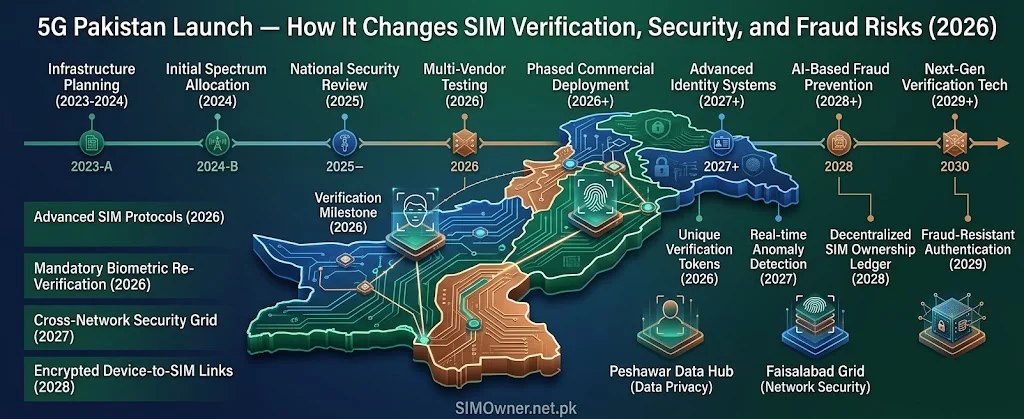
5G Timeline in Pakistan — What to Expect
| Phase | Timeline | Status |
|---|---|---|
| Spectrum auction completion | 2024–2025 | Completed |
| Initial commercial deployment (3 cities) | 2025–2026 | Underway |
| Major city coverage expansion | 2026–2027 | Planned |
| Nationwide significant coverage | 2028–2030 | Projected |
| Full 4G-to-5G migration for most users | 2030+ | Long-term |
Pakistan’s 5G timeline is realistic but not aggressive by regional standards. For most Pakistanis, 5G will be a gradual background upgrade rather than an abrupt transition. The SIM registration and fraud protection landscape will evolve in parallel with the network deployment.
Frequently Asked Questions
Q: Do I need a new SIM for 5G in Pakistan?
A: In most cases, yes — 5G requires a 5G-compatible SIM card (sometimes called a “5G SIM” or “NR SIM”). However, major Pakistani operators have begun issuing SIM cards that support both 4G and 5G, so new SIMs issued after 2024 may already be 5G-capable. Check with your specific operator whether your current SIM supports 5G, or whether a free SIM upgrade is needed.
Q: Will my CNIC registration transfer automatically if I upgrade to a 5G SIM?
A: Yes — a 5G SIM upgrade (whether through operator replacement or eSIM activation) transfers your existing registration. Your CNIC remains linked to your number. No new CNIC verification is required for a same-number SIM upgrade to 5G capability.
Q: Is 5G more susceptible to SIM swap fraud?
A: No — 5G does not increase SIM swap vulnerability. SIM swap fraud exploits franchise-level verification processes, not network technology. If anything, 5G’s stronger network-level authentication reduces certain sophisticated attack vectors, while leaving the franchise-level fraud risk unchanged.
Q: Can criminals use 5G equipment for IMSI catching in Pakistan?
A: 5G’s SUPI concealment specifically addresses IMSI catching by encrypting subscriber identity in initial connections. Criminals using 5G-band equipment face a fundamentally harder task than with 4G band IMSI catchers. However, in hybrid 4G/5G environments, devices that fall back to 4G for any reason are still vulnerable to 4G IMSI catching during that fallback period.
Q: Does Raast or JazzCash work differently on 5G?
A: No — mobile payment applications (Raast, JazzCash, Easypaisa) function identically on 4G and 5G. The payment infrastructure operates at the application layer — entirely independent of the network generation’s radio access technology.
Q: My phone shows “5G” but I am not in a 5G coverage area. Why?
A: Some Android phones display “5G” when connected to a specific 4G LTE-Advanced configuration (called 5G Evolution or 5Ge by some operators) — this is a marketing designation, not true 5G NR (New Radio). True 5G NR is available only in formally designated 5G coverage areas. Check your specific operator’s 5G coverage map.
Summary: 5G and SIM Security — Key Points
| Aspect | 5G Impact |
|---|---|
| SIM registration process | No change — same CNIC + biometric |
| PTA SVMS registration | No change |
| 668 verification service | No change |
| 8-SIM CNIC limit | No change |
| Network-level authentication | Improved (SUPI, 5G-AKA) |
| IMSI catching resistance | Improved |
| SS7 vulnerability | Partially improved (hybrid environment) |
| Franchise fraud risk | No change |
| Social engineering risk | No change |
| CNIC breach exposure | No change |
Bottom line: 5G improves specific network-protocol-level security while leaving the franchise verification and social engineering fraud landscape completely unchanged. The most impactful SIM security measures for Pakistani users remain the same in the 5G era as in the 4G era.
For Pakistan’s most comprehensive SIM security resources and verification tools, visit SimOwner Details — Pakistan’s trusted SIM information resource since 2015.
5G technical specifications based on 3GPP Release 15/16/17 standards. Pakistan 5G deployment details from PTA public statements and operator press releases as of May 2026. SimOwner.net.pk is not affiliated with PTA or any network operator.
Related Guides on SimOwner.net.pk: