
Last Verified: May 2026 | By SimOwner.net.pk Editorial Team — Pakistan’s SIM fraud documentation specialists since 2015
Your CNIC number is on your electricity bill, your bank account application, your apartment rental agreement, your university enrollment form, and possibly dozens of franchise SIM registration records from the past decade. Every one of those copies is a potential source for a criminal who wants to register a SIM in your name.
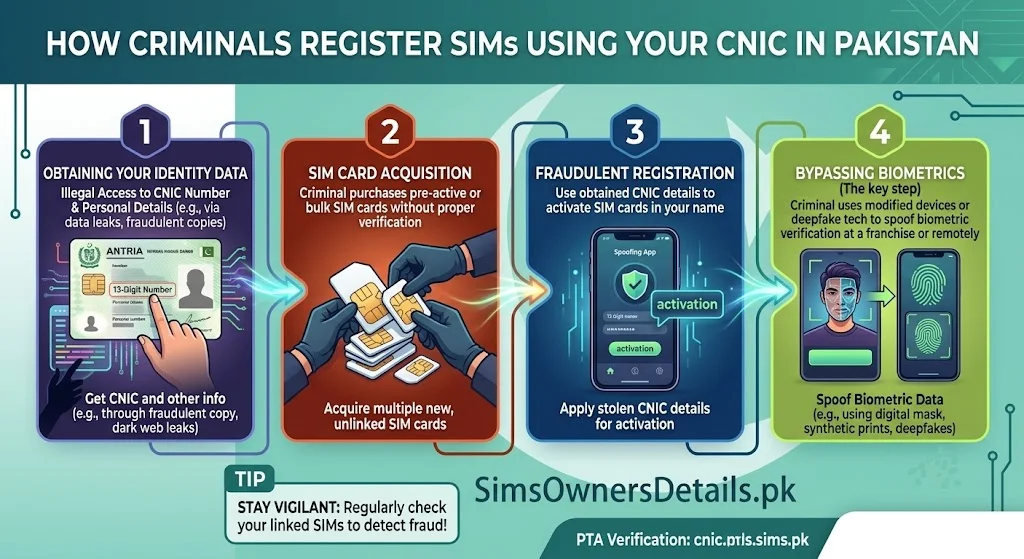
The alarming reality: registering a fraudulent SIM in someone else’s name in Pakistan requires only three things — the victim’s CNIC number, a corrupt or careless franchise employee, and approximately 10 minutes. The criminal does not need your physical CNIC. They do not need your fingerprint in many documented cases. They need your 13-digit number and someone willing to bypass the verification system.
This guide explains the exact methods criminals use, which weaknesses in Pakistan’s SIM registration system they exploit, and the specific preventive measures that make your CNIC significantly harder to target. Start by verifying how many SIMs are currently registered on your CNIC right now at CNIC Information — if the number is higher than what you registered, a fraudulent SIM may already exist.
The Criminal’s Resource: Where Your CNIC Number Comes From
Before a criminal can register a fraudulent SIM using your CNIC, they need your CNIC number. Understanding their acquisition methods helps you understand where your exposure actually is.
Source 1 — Breach Databases
As documented in our CNIC Data Breach Pakistan guide, Pakistan has experienced multiple large-scale subscriber database leaks. The 2019 breach alone exposed approximately 115 million Pakistani subscriber records including CNIC numbers, phone numbers, and home addresses. These databases are traded on dark web forums and Pakistani criminal networks at prices ranging from a few thousand to hundreds of thousands of rupees.
A criminal who purchases even a small subset of this data has thousands of valid Pakistani CNIC numbers paired with phone numbers — a ready-made target list for SIM fraud operations.
Source 2 — CNIC Photocopy Collection Points
Every entity in Pakistan that collects a CNIC photocopy is a potential leak source:
- Mobile network franchises (ironic — the same places that should protect your identity)
- Banks and microfinance institutions
- Utility companies (WAPDA, SNGPL, PTCL)
- Landlords and property managers
- Universities and schools
- Government offices
- Hospitals and clinics
A franchise employee who processes hundreds of CNIC photocopies per week has access to hundreds of CNIC numbers. Even one dishonest employee at one location can supply criminal networks with thousands of valid CNICs over their tenure.
Source 3 — Social Engineering and Public Information
CNIC numbers are sometimes visible in public contexts — photographed documents shared on social media, CNIC images sent via WhatsApp for informal verification purposes, or CNIC numbers mentioned in public documents. Pakistan’s CNIC number format (XXXXX-XXXXXXX-X) is predictable by region — the first 5 digits encode the district of registration, which narrows the search space significantly.
Source 4 — Inside Access
Some criminals have inside connections — family members or contacts who work at NADRA, network operators, banks, or government offices with legitimate access to CNIC databases. Inside access provides both the CNIC number and sometimes additional information that makes fraud easier to execute.
The Exact Method: How a Fraudulent SIM Is Registered
Understanding the criminal’s step-by-step process is essential for understanding which protections work and why.
The Standard Franchise Bypass Method
Step 1 — Target selection. The criminal selects a CNIC number from their acquired database. They may verify the target is “valuable” by checking whether the associated phone number is still active (calling it or checking via network lookup).
Step 2 — Franchise selection. Not all franchises are equally vulnerable. Criminals specifically target:
- Small third-party franchise agents (not official network experience centers)
- Franchises in low-supervision areas
- Franchises known within criminal networks to have employees willing to accept bribes
- Franchises during shift changes or periods of staff distraction
Step 3 — CNIC number presentation. The criminal presents your CNIC number — either memorized, on a document, or on a counterfeit CNIC card. A counterfeit CNIC is more convincing but not always necessary; some franchise employees process registrations with minimal documentation scrutiny.
Step 4 — Biometric bypass. This is the critical step. PTA’s regulations require biometric fingerprint verification via NADRA MBVS for every SIM registration. How criminals bypass this:
- Bribery: The most common method. The criminal pays the franchise employee to mark the biometric verification as “completed” or “system down” without actually completing it. Documented bribe amounts range from Rs. 500 to Rs. 5,000 per fraudulent SIM.
- System error exploitation: During genuine MBVS outages or technical issues, some franchise employees — improperly — process registrations without completed biometric verification. Criminals time their attempts for known outage windows.
- Fake biometric devices: In rare documented cases, biometric scanner data has been manipulated at franchise level to return a “verified” response without actual fingerprint matching.
- SIM replacement pathway: For replacement requests (reported lost/stolen), some networks have historically had weaker verification requirements than new registrations. Criminals claim the target’s SIM is lost and request a replacement — bypassing new registration biometric requirements.
Step 5 — SIM activation. Once registered, the SIM activates on the network. The criminal now has a working SIM with your phone number (if it was a replacement) or a new number in your name. Either way, it is registered against your CNIC.
Step 6 — Exploitation. The SIM is used for:
- OTP interception (if it replaced your actual number)
- Mobile wallet registration (JazzCash, Easypaisa accounts opened in your name)
- Loan applications on fintech platforms
- Criminal communications (calls and messages untraceable to the criminal’s real identity)
- Resale to other criminals who need “clean” SIMs for fraud
The Numbers: How Many Fraudulent SIMs Are Registered in Pakistan
PTA’s enforcement data provides a window into the scale of the problem:
| Year | SIMs Suspended/Blocked | Primary Reason |
|---|---|---|
| 2021 | ~1.2 million | Unverified registrations |
| 2022 | ~2.1 million | Biometric verification failures |
| 2023 | ~3.4 million | Compliance audit findings |
| 2024 | ~4.1 million | Enforcement sweep |
| Jan 2026 | 4.7 million | Comprehensive verification audit |
The January 2026 sweep — 4.7 million SIMs suspended in a single enforcement action — represents approximately 3–4% of Pakistan’s total active SIM base. Each of these SIMs was registered with incomplete or fraudulent verification. Not all were criminal fraud — some were legitimate users with biometric issues — but the scale demonstrates that verification bypass is systematic, not exceptional.
7 Proven Methods to Protect Your CNIC From SIM Fraud
Method 1 — Check Your CNIC’s SIM Count Regularly (Free, 30 Seconds)
The fastest protection is early detection. Send your CNIC number (without dashes) to 668 from any Pakistani network. The response shows every SIM currently registered on your CNIC across all five networks.
Do this check once per month minimum. If you see a SIM you did not register — act immediately. The SimOwner.net.pk SIM database verification tool guides you through interpreting the results and what to do for each scenario.
Why monthly? Criminals typically use a fraudulent SIM for 2–4 weeks before it is flagged by PTA monitoring systems. Monthly checks catch most fraud within this window.
Method 2 — Request a Fraud Flag on Your Network Accounts
Call the customer service line for every network where you have a SIM and request that a security note be added to your account: “Require enhanced in-person biometric verification for any SIM replacement or account changes.”
This note alerts franchise staff that your account has heightened security requirements. While it does not prevent a corrupt employee from bypassing verification, it creates a documented paper trail and alerts honest employees to be more careful.
| Network | Customer Service |
|---|---|
| Jazz | 111-225-111 |
| Zong | 310 |
| Telenor | 345 |
| Ufone | 333 |
| SCO | 051-111-726-726 |
Method 3 — Update Your NADRA Biometric Data
Outdated biometric data creates verification failures — which some employees bypass rather than refer to NADRA. Current biometric data means successful verification is more likely, reducing the frequency of “system issues” that criminals exploit.
Visit any NADRA Registration Centre for a biometric update if your CNIC was last renewed more than 5–7 years ago. This is a free service.
Method 4 — Minimize CNIC Photocopy Distribution
Every photocopy of your CNIC is a potential source of the number criminals need. Practical steps:
- Write “For [specific purpose] only — Not valid for SIM registration” on any photocopy you provide
- Use digital copies where possible — email a scanned image rather than handing over a physical photocopy that can be further copied
- Ask entities collecting your CNIC photocopy why they need it — many requests are unnecessary
- Never send CNIC images on WhatsApp to unknown parties
Method 5 — Enable WhatsApp Two-Step Verification
A fraudulent SIM registered in your name can be used to re-register your WhatsApp. Two-Step Verification (WhatsApp → Settings → Account → Two-Step Verification) requires a PIN in addition to the OTP — blocking WhatsApp takeover even if someone has a SIM with your number.
Method 6 — Monitor New SIM Registrations on Your CNIC
Beyond monthly 668 checks, the CNIC information tools at SimOwner.net.pk allow you to track and understand the complete registration profile of your CNIC — which networks have SIMs, when they were registered, and how to respond if something is wrong.
Method 7 — Block Unauthorized SIMs Immediately
If a 668 check reveals unauthorized SIMs, do not wait:
- Call the relevant network’s fraud line immediately
- File an FIA complaint at complaint.fia.gov.pk
- File a PTA complaint at complaint.pta.gov.pk
- File a police FIR (PECA 2016 Section 16)
Speed matters — every hour the fraudulent SIM is active, it can be used for further fraud in your name.
What Happens to the Franchise Employee Who Registers Fraudulent SIMs
Understanding the consequences for complicit franchise employees explains why bribery remains the primary bypass method — the penalties, while real, are inconsistently enforced.
PTA regulatory consequences:
- Franchise license suspension or cancellation
- Financial penalties up to Rs. 100,000 per unauthorized registration
- Network operator contractual penalties
Criminal consequences under PECA 2016:
- Section 16 (Identity information crimes): Up to 3 years imprisonment, Rs. 5,000,000 fine
- If the employee is a principal conspirator in a larger SIM fraud operation, additional charges under financial crimes laws
In practice: Many franchise employees involved in SIM fraud are dismissed but not criminally prosecuted — partly because proving individual employee involvement requires digital forensics that local police are not always equipped to perform. FIA’s Cybercrime Wing has stronger forensic capability — which is why FIA complaints (not just police FIRs) are important.
PTA’s 2026 enforcement directive has strengthened franchise accountability — network operators are now required to maintain CCTV records of all SIM registration transactions for a minimum of 90 days, specifically to enable post-fraud forensic investigation.
The Role of CNIC Numbers in Pakistan’s Criminal Economy
Pakistan has a documented underground market for CNIC-based fraud services. Understanding this market explains why the problem persists despite PTA’s enforcement efforts:
CNIC number packages: Sold in bulk — thousands of CNIC numbers with associated phone numbers. Priced by recency and verification status (whether the number is still active).
“Clean SIM” services: Fraudulent SIMs registered on innocent third parties’ CNICs, sold to other criminals who need untraceable communication. Priced per SIM.
Full fraud packages: CNIC number + associated phone number + a fraudulently registered SIM + a JazzCash account opened on that SIM — sold as a complete fraud toolkit.
Each element of this chain represents a criminal enterprise — and each innocent Pakistani CNIC holder whose information is in these packages is a victim of identity fraud, regardless of whether they experience any direct financial loss.
Frequently Asked Questions
Q: Can a criminal register a SIM in my name even if my CNIC is not expired?
A: Yes. An active, valid CNIC provides more “value” to criminals than an expired one — because active CNICs pass PTA’s initial validation checks. Expiry status does not protect you from unauthorized SIM registration.
Q: If I check 668 and see only the SIMs I registered, am I definitely safe?
A: The 668 check shows currently active SIMs. It does not show SIMs that were registered and then deactivated (used briefly for fraud and then discarded). For a complete history, a formal PTA data request is required — but ongoing monthly 668 checks remain your best practical monitoring tool.
Q: My 668 check shows 3 SIMs but I only have 2. What should I do?
A: Treat this as confirmed fraud. Call the network the unknown SIM belongs to (identifiable from the number prefix), report it as a fraudulent registration, and file FIA and PTA complaints immediately. Do not wait to confirm further.
Q: Can updating my CNIC (renewing it) protect me from SIM fraud?
A: CNIC renewal updates your photograph and biometric data but does not change your CNIC number. The number criminals have acquired from breach databases remains valid regardless of renewal. Renewal does update your biometric templates in NADRA’s system — making legitimate verification easier and reducing the frequency of bypass-worthy technical failures.
Q: Is it illegal to sell CNIC photocopies to criminals?
A: Yes. Under PECA 2016 Section 16, selling, transmitting, or providing another person’s identity information (including CNIC numbers) without authorization and with intent to facilitate harm is a criminal offence carrying up to 3 years imprisonment and Rs. 5,000,000 fine.
Q: My neighbor said his CNIC had 11 SIMs registered. Is that possible?
A: The legal limit is 8 SIMs per CNIC. If 11 appear, several are definitively fraudulent registrations. PTA’s system should have flagged this — but enforcement gaps mean some registrations above the limit occur before automated blocks trigger. This is exactly the scenario the 668 check and monthly monitoring catches.
Q: If I report a fraudulent SIM and it gets deactivated, will the criminal face any consequences?
A: Deactivation alone does not guarantee prosecution. FIA investigation — triggered by your FIA complaint — is required for criminal consequences. The more evidence you provide (668 screenshot, network fraud report, FIA complaint, police FIR), the stronger the investigative foundation. Cases where the fraudulent SIM was used for financial crimes (JazzCash fraud, bank OTP theft) are prioritized by FIA.
Summary: Your Complete Protection Checklist
Do today:
- Send CNIC to 668 — verify current SIM count
- If unauthorized SIM found — call network fraud line immediately
- Call your network(s) — request fraud flag on account
Do this week:
- Enable WhatsApp Two-Step Verification
- Review and limit CNIC photocopy distribution going forward
- Visit NADRA for biometric update if CNIC is old
Do monthly:
- 668 check — one minute, every month
- Review bank/wallet transaction history for unauthorized activity
If fraud occurs:
- File FIA complaint — complaint.fia.gov.pk
- File PTA complaint — complaint.pta.gov.pk
- File police FIR citing PECA 2016 Section 16
- Block unauthorized SIM through network
Criminal SIM registration using your CNIC is a systematic problem in Pakistan — but it is a detectable and preventable one. The criminals rely on two things: access to your CNIC number, and your lack of monitoring. Remove the second element with monthly 668 checks and network fraud flags, and you dramatically reduce your risk.
For Pakistan’s most comprehensive SIM verification and CNIC protection tools, visit Sim Owner Details — independently tracking Pakistan’s telecom fraud landscape since 2015.
All PTA enforcement figures sourced from publicly available PTA press releases and annual reports. PECA 2016 legal references current as of May 2026. SimOwner.net.pk is not affiliated with PTA, NADRA, or any network operator.
Related Guides on SimOwner.net.pk:
- How to Write an FIR for SIM Fraud in Pakistan — Exact Wording, PECA Sections, and Documents Required (2026)
- Corporate SIM Registration in Pakistan 2026 — Complete NTN-Based Guide for Businesses and Startups
- Pakistan Data Protection Law 2025 (PDPA) — How It Protects Your CNIC and SIM Information (Complete Guide)